
By Glenn A. Johnson
We are living through the loneliest era in human history—and many of us seem to prefer it that way.
Journalist Derek Thompson points to a striking reality: Americans now spend 20 percent less time socializing in person than they did just two decades ago. But this is not simply a matter of circumstance… it is a choice. We are opting out of community. We are retreating into our screens.
Thompson calls it the Anti-Social Century—a time when each technological leap makes life more convenient, but also more isolating.
Where, in this shifting landscape, do books still belong?
The Quiet Power of Story
Books are often seen as solitary objects. And yet, reading is among the most social things we do. Every time we open a novel, a memoir, or a children’s story, we step into another mind, another way of seeing the world. In this way, books have always been bridges, quietly helping us build empathy, attention, and imagination.
But these habits are under threat.
According to the National Literacy Trust in the U.K., fewer children are reading for pleasure than ever before—the lowest levels since tracking began in 2005. And yet the research is clear: those who do read regularly have stronger mental health, higher empathy, and better life outcomes. The connection is not accidental.
When we stop reading stories, we do not just lose language—we lose perspective. We lose the ability to imagine other lives. And, perhaps, to care about them.
Screens That Divide Us
Thompson describes how our tools have slowly pulled us apart. The car privatized our geography. The television privatized our leisure. And now, the smartphone has privatized our attention entirely.
Even when we are with others, we can choose to disappear into the glow of a screen. And for many, that has become the norm.
Philip Pullman, beloved author of His Dark Materials, has long warned about this disconnection. He reminds us: “Children need art and stories and poems and music as much as they need love and food and fresh air and play.”
When children lose touch with stories, they lose something foundational—their imaginative lives. And without that, how can they dream, grow, or care deeply about the world around them?
A New Kind of Companionship
Artificial Intelligence now offers not just answers, but companionship. Chatbots and AI-based friends are filling a new niche: responding with comfort, mirroring emotion, and providing affirmation on demand. These relationships can feel safe. Predictable. Effortless.
But are they real?
Thompson notes that many young people already carry out their friendships entirely through their phones, via memes, texts, and emojis. When the relationship is reduced to bubbles of text, is there truly a meaningful difference between messaging a friend and messaging a machine?
This is the deeper risk. Not that AI will replace people, but that we will begin to prefer it.
Why Books Still Matter
In this moment of quiet crisis, books do not shout for our attention. They offer something harder—a chance to slow down, to think deeply, to feel fully.
Reading is not a passive act. It is a collaboration between author and reader. And in an age of constant distractions and curated loneliness, that collaboration may be the most human thing we have left.
The future of books is not something to be forecasted. It is something we must actively choose.
Choose stillness. Choose story. Choose the book.
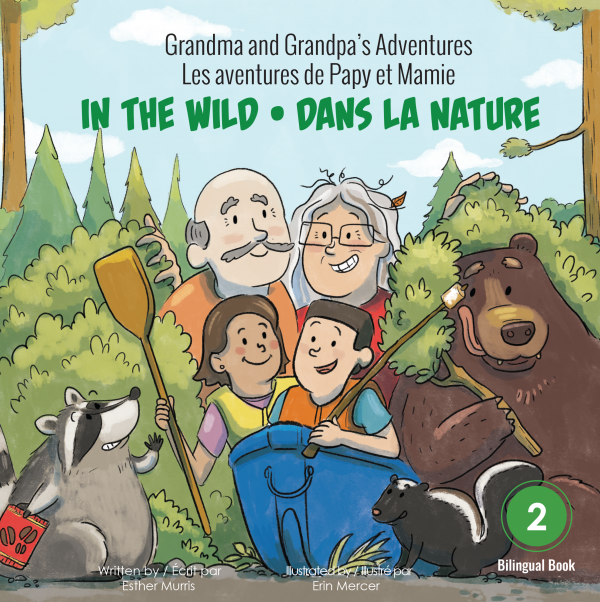
See DC Canada’s bilingual trilogy about grandparents connecting with their grandkids here.
Glenn A. Johnson is an accomplished writer, newspaper editor-in-chief, and journalist with a career spanning 40 years. His work with The Canadian Press has appeared in every Canadian daily newspaper. He also wrote for The Wall Street Journal and The Sunday Telegraph in London and spent time in Abu Dhabi as an editor for The National.
Glenn has transitioned his storytelling skills into writing for children’s books. He creates engaging stories that entertain young readers while addressing essential themes like social-emotional learning (SEL), inclusion, and acceptance. As a proud member of the Society of Children’s Book Writers and Illustrators and the Canadian Society of Children’s Authors, Illustrators and Performers, Glenn is dedicated to crafting stories that help children learn, grow, and connect.
Glenn is also an international voiceover artist, musician, and radio host (QCCRFM.COM).
Glenn and his partner Pamela live in Ottawa.